



Responsibility for the environment
We see responsibility for the environment as a firm component of our mandate and our actions. Sustainability is not a byword for us; instead, it is a long-term obligation towards our region, our stakeholders, as well as future generations.
To that end, we address our impacts on the environment in a structured way: We calculate our emissions, record relevant environmental aspects and monitor their development. That enables us to create transparency in relation to our environmental footprint as well as a factual basis for sound decisions and transparent measures.
We calculate our emissions in accordance with the Greenhouse Gas Protocol. Carbon emissions are accordingly divided into three scopes:
- Scope 1: direct emissions from the use of fossil fuel sources, for example heating systems or company vehicles
- Scope 2: indirect emissions from the purchase of electricity or heating
- Scope 3: indirect emissions arising outside the bank’s own operations along the upstream and downstream value chain, particularly financed emissions resulting from the financing of real estate or companies as well as from investments in the context of asset management mandates or investment funds
Climate impact of Zuger Kantonalbank for the 2025 financial year
| Scope | Emissions (t CO2e) | |
|---|---|---|
| Operations1 | 1, 2, 3 | 203 |
| AM mandates and ZugerKB investment funds | 3 | 30,184 |
| Financial investments | 3 | 6,346 |
| Corporate loans 3 | 3 | 61,094 |
| Mortgages and commercial properties 3 | 3 | 37,710 |
1 This includes all direct and indirect emissions from operations (Scope 1 and 2) as well as emissions from business travel using private vehicles (Scope 3).
Own operations
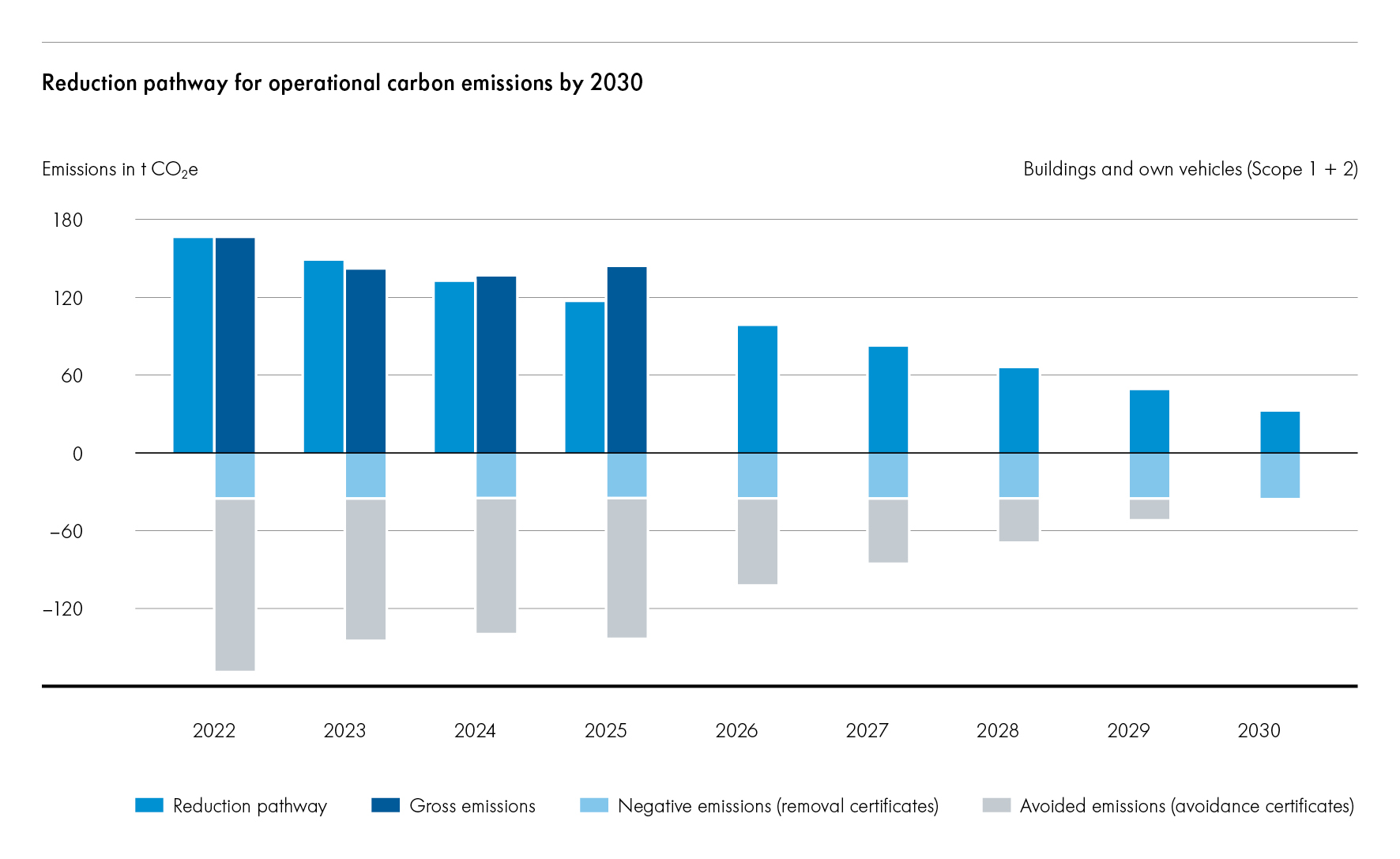
By 2030, we intend to reduce our operational carbon emissions from Scope 1 and Scope 2 by at least 80 percent compared with 2022 and to no longer use fossil fuels in our operations. The remaining emissions are offset through carbon credits, enabling us to support projects to avoid and remove CO2. In terms of our operations, we aim to achieve net zero by 2030.
The following measures have already been implemented:
- Energy optimisations and regular consumption monitoring for all Zuger Kantonalbank buildings
- Availability of electric cars and e-bikes as well as Mobility partnership for business travel
- Electricity from 100 percent renewable energy sources and promotion of solar power
- Switching our own buildings from fossil-fired to renewable heating systems
- Mandatory employee training on environmental and climate awareness
Lending business
Emissions from the lending business account for a substantial portion of our total emissions. This is where Zuger Kantonalbank – together with its clients – has the greatest leverage. When determining climate targets from our balance sheet business, we are guided by the federal government’s climate strategy and its aim of achieving carbon neutrality by 2050 at the latest.
In 2025, we defined a reduction pathway for our mortgage portfolio: The aim is to achieve a 55 percent reduction in the carbon intensity of real estate financing by 2035 compared with 2023. This covers owner-occupied residential properties as well as the financing of commercial properties including residential properties leased to third parties.
The following measures have been introduced:
- Raising client awareness and inclusion in the advisory process, supported by the Wüest Refurb tool
- Improving data quality through systematic recording of heating types and renovations
Investment business
Based on emissions data as at the end of 2022, we formulated a 35 percent reduction pathway for carbon intensity by 2030 for each of our in-house equity funds. This takes account of emissions data for Scope 1 and Scope 2. The reference values (starting points) for the reduction pathways are based on the carbon intensities of the respective benchmark indices at the end of 2022. These targets were approved by the Swiss Financial Market Supervisory Authority FINMA on 1 July 2025. The data for the calculations was obtained from MSCI ESG Research LLC. The aim is a weighted average carbon intensity that is below a reduction value which is reduced by 5.24 percent annually versus the reference values of the respective comparative benchmarks as at 31 December 2022. For the first time, the reference values had to be met at the end of 2025.
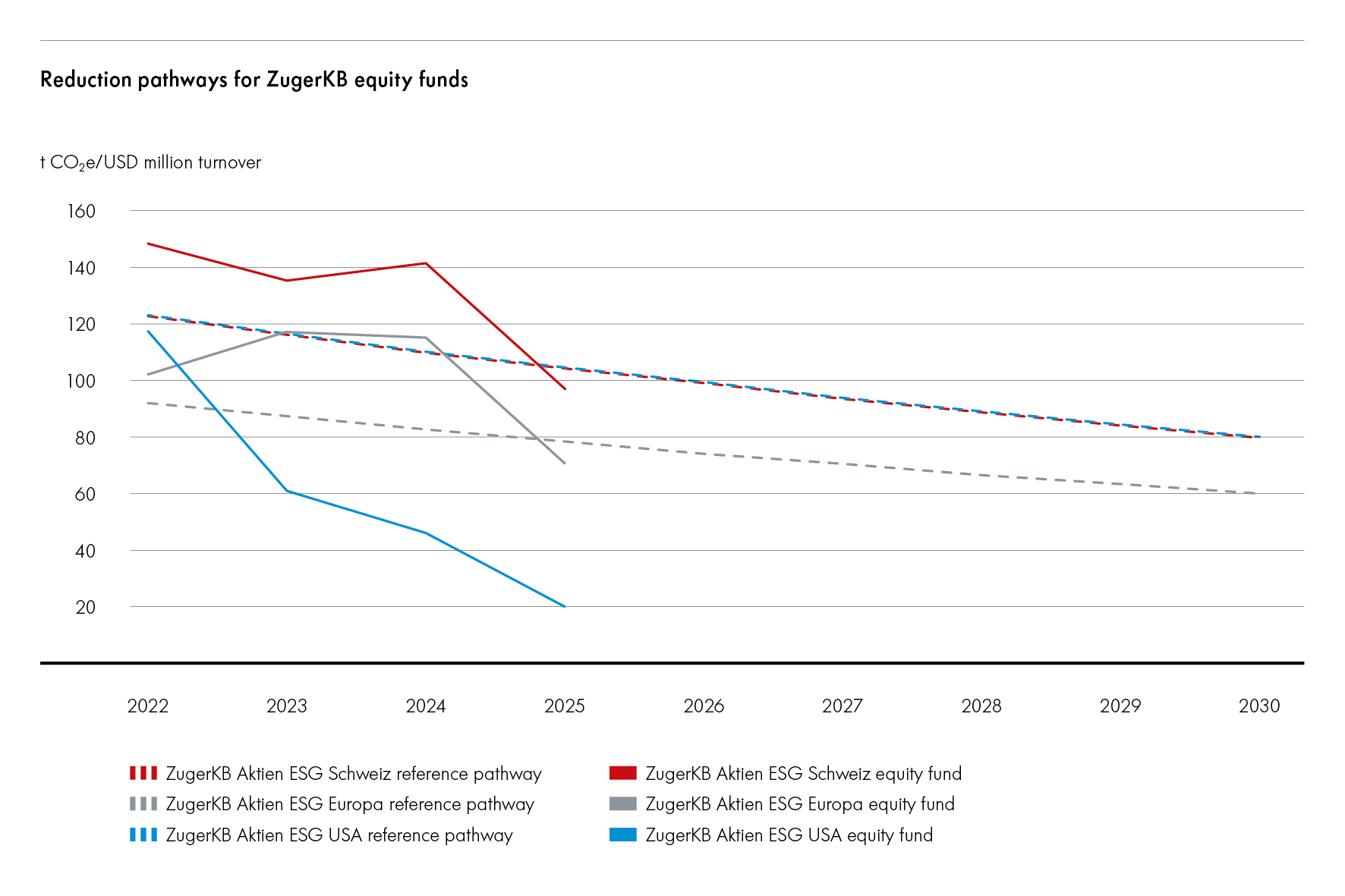
Measures for our ZugerKB equity funds:
- Carbon intensity is taken into account when the funds are constructed.
- We abide by the Swiss Stewardship Code as well as the Principles for Responsible Investment (PRI) through proxy voting (exercising shareholder voting rights) and engagement (active dialogue with companies).